

Exomind® for Cravings

Break Free from Cravings – Transform Your Weight Loss Journey with EXOMIND®
Because Weight Management Involves the Brain — Not Just Willpower
If you’ve ever promised yourself you’d eat better, only to find yourself reaching for sugar, snacks, or late-night comfort food—you’re not weak. Your brain is wired to seek quick energy and relief under stress.
That’s why diets alone so often fail. They focus on calories, but not on the neural pathways and stress responses driving the cravings.
This is where EXOMIND® comes in.

Why the Brain Matters
Eating behavior is influenced by much more than the stomach. The prefrontal cortex, an area of the brain responsible for decision-making and cravings.

This area of the brain helps process:
Hunger and fullness signals
Reward and anticipation
Emotional responses
Attention
Habit formation
Decision-making
Impulse control
The ability to pause before acting
The value assigned to immediate versus long-term rewards
Transcranial Magnetic Stimulation (TMS) is a safenon-invasive therapy that uses magnetic pulses to stimulate specific areas of the brain involved in appetite regulation, impulse control, and metabolism. Originally developed to treat depression, TMS is now showing promising results for weight loss by helping individuals regain control over their eating habits.
By directly stimulating the brain regions responsible for self-regulation, TMS helps rewire unhealthy eating patterns—offering long-term success in weight management.
EXOMIND® helps:
Reduce food cravings and compulsive eating behaviors.
Rebalance stress pathways that drive emotional eating.
Improve focus and impulse control, making it easier to stick to healthy choices.
Support mood regulation, so you’re not reaching for food as a coping mechanism.
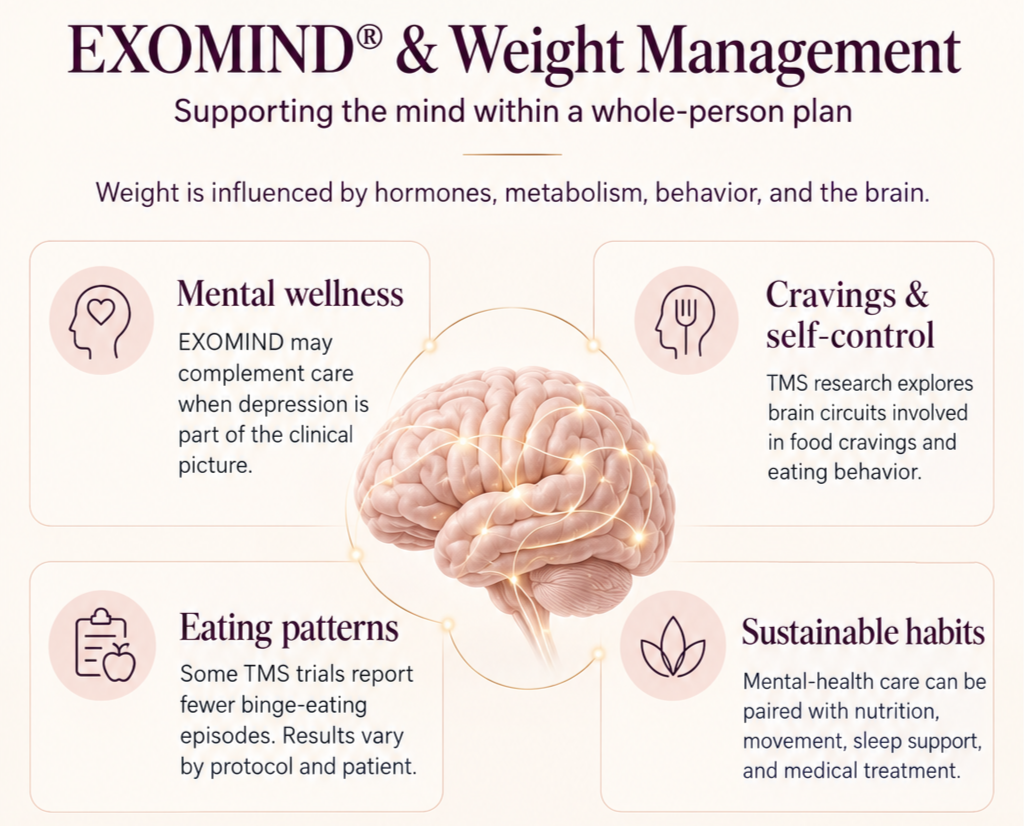
📚 What the research tells us:
A study in Obesity found that TMS helped reduce binge eating episodes and improve impulse control.
Research in NeuroImage showed that stimulating the dorsolateral prefrontal cortex (DLPFC) reduces cravings for high-calorie foods.
FREQUENTLY ASKED QUESTIONS
-
For some people, food occupies an exhausting amount of mental space. This persistent mental chatter is often called food noise.
It may feel like:
Constantly thinking about what or when you will eat
Mentally reviewing food choices throughout the day
Feeling preoccupied with foods you are trying to avoid
Thinking about food soon after finishing a meal
Feeling unable to concentrate when a craving is present
Frequently negotiating between eating and restricting
Using food to manage stress, boredom, sadness, or overwhelm
-
EXOMIND® is not yet an FDA-cleared treatment for binge-eating disorder or food noise. Emerging research suggests that repetitive transcranial magnetic stimulation may help reduce binge frequency in some patients.
-
You may be considered for treatment if you are in a weight management program elsewhere after a consultation with our physician who will determine if Exomind is appropriate for you.