

Styku® Scan
Styku® 3D Body Composition Tracking
See the Progress the Scale Cannot Show
Your weight is one measurement. It is not the complete story.
A traditional scale cannot tell us whether your weight change came primarily from fat, lean tissue, fluid, or a combination. It cannot show whether your waist is becoming smaller, your body shape is changing, or your muscle-to-fat balance is moving in the right direction.
Styku® uses noninvasive 3D imaging to create a digital model of your body, calculate circumference measurements, estimate body composition, and visually compare changes over time.
At Total Illusion, Styku® is integrated into medical weight management to help Dr. Eakin look beyond pounds and monitor the outcomes that matter for your metabolic health, strength, function, and long-term success.
Weight Loss and Fat Loss Are Not the Same
When the number on the scale decreases, the weight lost may include:
Body fat
Lean tissue
Water
Glycogen
Contents of the digestive tract
A combination of these factors
The goal of a thoughtful weight-management program is not simply to make your body smaller.
Ideally, your plan should:
Reduce excess body fat
Decrease abdominal measurements
Preserve as much muscle and functional strength as possible
Improve cardiometabolic health
Support mobility and energy
Create results that can be maintained
Styku® provides another layer of information to help us evaluate whether the plan is moving you toward those goals.
What Is Styku®?
Styku® is a noninvasive three-dimensional body scanner.
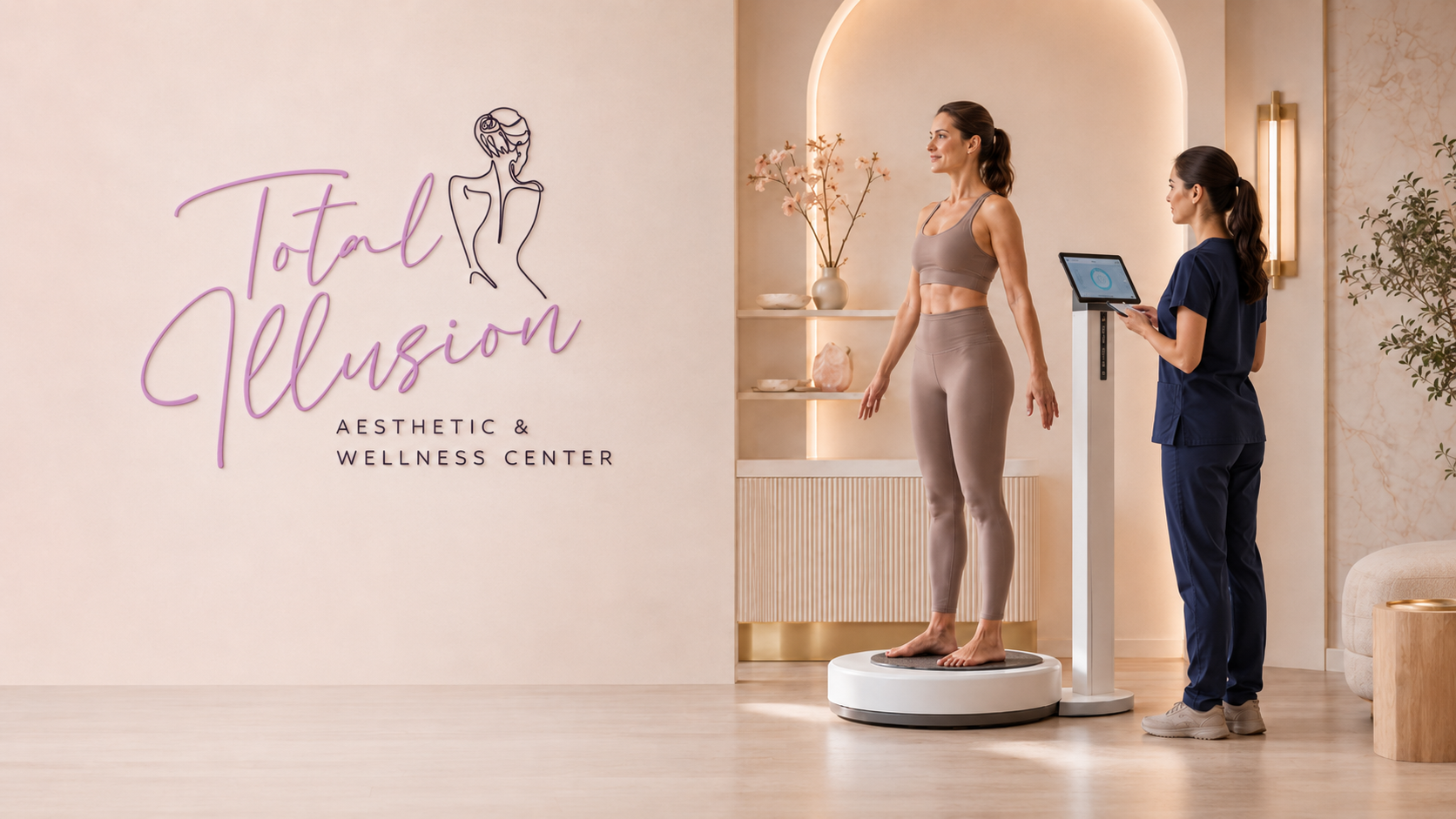
During the scan, you stand on a rotating platform while an infrared camera captures the shape and dimensions of your body. The system then creates a digital 3D model and generates measurements and estimated body-composition values.
Styku® uses infrared imaging rather than ionizing radiation or electrical current.
Depending on the software configuration and report selected, your scan may include:
Body weight
Body-fat percentage
Estimated fat mass
Estimated lean mass
Waist circumference
Hip circumference
Waist-to-hip ratio
Waist-to-height ratio
Chest, arm, thigh, and other circumference measurements
Android, or central-body, fat estimates
Gynoid, or lower-body, fat estimates
Estimated visceral and subcutaneous abdominal fat
Posture or body-alignment information
Side-by-side visual comparisons between scans
The individual measurements and estimates are interpreted as part of your clinical plan rather than treated as diagnoses by themselves.
Your First Scan Establishes a Baseline
Your initial Styku® scan provides a starting point before or near the beginning of your medical weight-management program.
A baseline helps us answer questions such as:
Where is your body currently storing more volume?
What is your starting waist measurement?
What are the estimated proportions of fat and lean mass?
Is excess weight concentrated primarily around the abdomen?
What measurements will be most meaningful for your goals?
How can we evaluate progress beyond scale weight?
Without a baseline, patients may lose significant weight but have difficulty remembering how much their shape, waist, and proportions have actually changed.
The 3D model creates a visual record that can be compared with later scans under similar conditions.
Why Waist Measurement Matters
Abdominal fat carries different health implications than fat stored primarily around the hips or thighs.
Waist circumference provides useful information about central adiposity and can add to the risk information provided by BMI alone. An international consensus statement recommends incorporating waist circumference into clinical practice because BMI and waist measurement together provide a more complete assessment of cardiometabolic risk than either measurement alone.
Styku can help us monitor whether your:
Narrowest waist is changing
Abdominal waist is decreasing
Lower waist is decreasing
Waist-to-height ratio is improving
Overall trunk volume is changing
A smaller waist may represent meaningful progress even during a period when the scale changes slowly.
Waist measurement does not diagnose diabetes, fatty liver disease, insulin resistance, or cardiovascular disease. Laboratory testing and medical evaluation remain necessary when those concerns are present.
Tracking Fat Loss
Styku® estimates body-fat percentage and fat mass using your 3D body-shape measurements and mathematical models.
This can help us follow whether your program appears to be producing a downward trend in:
Total estimated fat mass
Body-fat percentage
Abdominal measurements
Central-body volume
Estimated abdominal fat
Protecting Lean Mass During Weight Loss
Losing excess fat is beneficial. Losing too much muscle or functional lean tissue is not the goal.
Lean mass includes:
Skeletal muscle
Organs
Bone
Water
Other nonfat tissues
Because lean mass is broader than muscle alone, a Styku® lean-mass estimate should not be described as a direct measurement of skeletal muscle.
However, a downward lean-mass trend may signal the need to review:
Protein intake
Total calorie intake
Resistance exercise
Rate of weight loss
Hydration and nutrition
Physical activity
Sleep and recovery
Hormonal or thyroid concerns
Illness, injury, or deconditioning
Medical weight loss should help you become healthier and more functional—not simply lighter.
Styku® During GLP-1–Supported Weight Loss
Medications such as semaglutide and tirzepatide can produce significant reductions in total weight and fat mass.
As with other forms of substantial weight loss, some lean mass may also decrease. The amount varies among patients and studies, and a reduction in measured lean mass does not always mean an equivalent loss of functional muscle. Clinical research nevertheless supports monitoring nutrition, strength, and body composition rather than assuming that every pound lost represents excess fat.
Styku® may help us identify patterns such as:
Weight decreasing while waist and fat estimates improve
Weight decreasing with relative preservation of lean mass
Rapid weight loss accompanied by a concerning lean-mass trend
Little scale change despite improved waist measurements
A plateau in both weight and body-composition change
The need to reinforce protein and resistance exercise
The transition from active weight loss to maintenance
Styku® cannot prove that a medication directly caused a particular change. The scan is interpreted alongside your diet, strength, symptoms, weight-loss pace, medication dose, and clinical history.
When the Scale Does Not Move
A stable scale does not always mean that nothing is changing.
For example, you may:
Lose fat while gaining or preserving muscle
Reduce your waist without a large change in total weight
Improve your proportions
Experience less abdominal fullness
Fit into smaller clothing
Become stronger and more physically active
Reduce body fat while retaining fluid temporarily
A repeat Styku® scan can help reveal these changes.
This can be especially encouraging for patients who have been working consistently but feel discouraged by normal fluctuations in scale weight.
Tracking Muscle-Support Interventions
Styku® may also help monitor your progress when the weight-management plan includes:
Resistance training
Increased protein intake
Physical therapy
EMSCULPT NEO®
Recovery from deconditioning
A transition into weight maintenance
For example, a patient may lose little additional scale weight while decreasing waist measurements and maintaining or improving estimated lean mass.
That may represent a more desirable body-composition outcome than rapid weight loss accompanied by declining strength.
Body Recomposition
Body recomposition refers to improving the relative proportions of fat and lean tissue rather than focusing only on weight loss.
A body-recomposition plan may involve:
Reducing excess fat
Preserving or building muscle
Improving waist measurements
Increasing strength
Supporting protein intake
Combining resistance and cardiovascular exercise
Maintaining a stable or gradually changing weight
Because muscle and fat occupy different amounts of space, body shape can change even when total body weight changes very little.
Styku®’s visual comparison and circumference measurements can make recomposition easier to recognize.
What Happens During a Styku® Scan?
Before the Scan
You will receive preparation instructions designed to improve consistency.
You may be asked to:
Wear form-fitting clothing
Remove shoes and bulky accessories
Remove jackets, belts, and items that alter your body outline
Avoid heavy clothing
Use the restroom beforehand
Avoid a very large meal immediately before scanning
Complete repeat scans under similar conditions when possible
Loose clothing can make circumference measurements less reliable because the scanner captures the outline it sees.
During the Scan
You will:
Stand on the rotating Styku® platform.
Position your feet and arms as instructed.
Remain still while the platform rotates.
Allow the infrared camera to capture your body shape.
Review the resulting 3D model and measurements.
The scan is quick, noninvasive, and does not use ionizing radiation or electrical current.
After the Scan
Dr. Eakin or the clinical team will review the results in the context of your:
Current weight-management stage
Health goals
Previous measurements
Nutrition and exercise plan
Medication use
Symptoms
Laboratory findings
Strength and function
Measure More Than Pounds
Weight is only one outcome.
A successful medical weight-management program should also consider fat loss, waist reduction, muscle preservation, strength, metabolic health, and how well your results can be maintained.
Styku® gives us a clearer way to see and measure those changes—so your progress is evaluated by more than the number beneath your feet.
FREQUENTLY ASKED QUESTIONS
-
Styku® uses infrared body-shape measurements and validated mathematical models to estimate body composition.
The manufacturer reports strong agreement with DEXA for fat-mass estimates and high repeatability for circumference measurements.
The most useful application is tracking trends under consistent conditions.
-
The two tools provide different information.
A scale measures total weight. Styku® adds circumference measurements, estimated fat and lean mass, body-shape ratios, and visual comparisons.
-
Styku® estimates lean mass, which includes muscle but also includes water, organs, bone, and other nonfat tissue.
It does not directly measure each skeletal muscle or determine how strong that muscle is.
-
Yes.
-
The software generates estimates or goals, but nutrition recommendations should be personalized according to your health, medications, activity, appetite, weight-loss stage, and nutritional needs.
-
It can help document changes occurring during treatment, including weight, waist, fat, and lean-mass trends.
It cannot determine by itself whether the medication is the cause of those changes or whether the medication is medically appropriate.
-
Some reduction in lean mass can occur during significant weight loss.
Dr. Eakin may review your protein intake, resistance exercise, weight-loss pace, hydration, medications, strength, and other clinical factors before deciding whether the plan needs adjustment.
-
That may indicate meaningful body recomposition or a change in fat distribution.
The scan should be interpreted alongside strength, activity, clothing fit, symptoms, and other measurements.
-
Styku® uses infrared imaging rather than electrical current or a magnetic field. The manufacturer states that the scanning technology can be used in people with pacemakers and other implanted devices.
-
No. The scanner uses infrared imaging and does not use ionizing radiation.
-
The image-capture portion is generally completed in less than a minute. Additional time is used to prepare, position you correctly, and review the results.
-
The visual model can be useful for tracking progress, but the experience should remain respectful and patient-centered.
Tell the team if viewing the image would make you uncomfortable or negatively affect your body image.
-
Most patients benefit from allowing enough time for meaningful change—often approximately 8 to 12 weeks between early scans rather than scanning every week.
Your schedule will be individualized.